

The year was 1812, 101 years before the 16th amendment was passed that enabled federal income tax in the country, and the Federal Reserve Act was passed that effectively established the Central bank in the US.
At the time, the United States government’s only source of revenue came exclusively customs duties, the official terminology for tariffs on maritime trade.
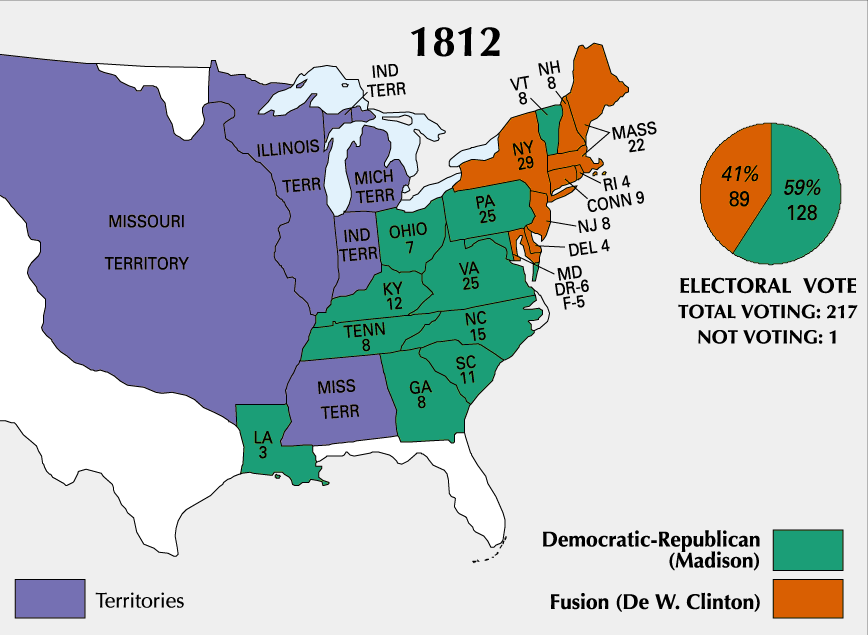
James Madison, the father of the US constitution, was elected as the 4th president of the United States, succeeding Thomas Jefferson. These 2 men were the founding fathers of the US that successfully defeated the British in the American Revolutionary War. Yes, they may have gained political independence from them, but unfortunately they would learn in the hardest way possible that the independence they have gained was nothing more than facade without financial sovereignty.
The Fragile Economic Model The US Government Operated On
Before the shooting war began, let’s first establish the economic model the US had. The main source of revenue for the US government is customs duties, which is the official terminology for tariffs on imported goods globally.
It accounted for over 90% of all federal tax revenue in the country, peaking at $16 million in 1808. The other 10% came from sales of public land and postal fees. The problem is that the US owned millions of acres of land and land inherently is an illiquid asset, meaning that it can take take time and effort to sell them and it can’t be quickly converted to cash without a substantial risk of losing value.

There wasn’t income taxes, excise taxes or even internal taxes. Before Madison became the US president, it was Thomas Jefferson, another founding father of the US, who sat in the oval office back in 1801. He and the democratic-republicans viewed the taxes mentioned as tyrannical and repealed mostly all of them.
To make matters worse, on March 1811, The First Bank of the United States, which was the first national bank created, was blocked in congress. Why? Because the democratic-republicans, the party who was against central power, was very wary about centralized financial power.
And the cherry on top of the cake was that residents in the New England States absolutely rejected the war with Britain, and they tried to hide their capital from them. That hurt the US very significantly because the needed a “specie”, which was a gold and silver coin, to pay soldiers, buy gunpowder and service the existing national debt.
And when the War of 1812 happened between the Americans and the British, history books focused on the shooting war. It may have ended in a stalemate via Treat of Ghent in 1814, but they never focused on the fact the British financially defeated the Americans.
How did they do it?
It was all through maritime insurance….
The 1.1 Square mile Location in Britain That Underwrites The Global Risk
In the 17th Century, long before the War of 1812, London was seeing an explosive growth in global trade all thanks to new trade routes and expansions in the Caribbean and Americas.
Shipping was a high-risk, high-reward industry. A merchant could be a millionaire on Tuesday and utterly bankrupt by Friday. The ships that sailed the oceans faced three existential threats: storms, pirates, and state-sponsored privateers. To survive this brutal climate, merchants required two things: real-time information on maritime hazards, and a mechanism to distribute risk.
This is where a savvy entrepreneur named Edward Lloyd stepped in. Running a London coffee house, Lloyd realized that brokering information about shipping was far more lucrative than selling coffee.
He began sending runners 74 miles southwest of London to the major port of Portsmouth. These runners questioned arriving captains about weather conditions, delayed vessels, and pirate sightings. They raced back to London with the data, which Lloyd posted wall-to-wall on blackboards inside his establishment.
By 1734, the world’s first systematic real-time shipping intelligence network was established, known as Lloyd’s List.
Because this data was incredibly valuable, wealthy commercial bankers and private investors flocked to the coffee house to buy it. Since no single man was wealthy enough to risk losing an entire ship and cargo alone, a revolutionary concept emerged: What if, instead of one person bearing the burden, a syndicated group of investors pooled their capital to split the risk?
That’s exactly how modern underwriting was born.
By officially formalizing their society and moving into the Royal Exchange in 1774 along with building a large, deep network of intelligence agents in every major port, Lloyd’s has basically created a massive geopolitical weapon.
The British crown ultimately discovered that the Royal Navy was not needed in order to paralyze one’s economy, all they had to do is to rely on Lloyd’s Joint War Committee to reclassify a trade route as “High Risk”.
With the spike in insurance premiums, London had the power to price out the merchant fleets from sailing the ocean before a single shot was fired.
When Congress in June of 1812 formally declared war, the United States, with its ships and trade goods is about to run head on with the kill switch London has.
The Kill-switch That Made The US Bankrupt
Earlier in this article, it’s been established that 90% of the US government’s revenue came from tariffs. During the War of 1812, the British Admiralty issued the order for the commercial blockades of both the Chesapeake Bay and the Delaware River, eventually expanding down the Atlantic coast that covers every major port in the US by 1814.
On the surface, it looks like a military blockade to prevent warships from going to the Atlantic ocean, but what many don’t realize is that the warships aren’t just present in those ports, it's also commercial fleets.
And that blockade, essentially targeted the biggest single-failure point the US had: Their tariffs.
The minute the blockade was issued, the runners over in Lloyd's in London posted this in the blackboards, things went south REAL fast over time.
The insurance premiums on American-bounded cargo was spiked to astronomical levels, often spiking to anywhere between 30% to 50% of the total value of the cargo.
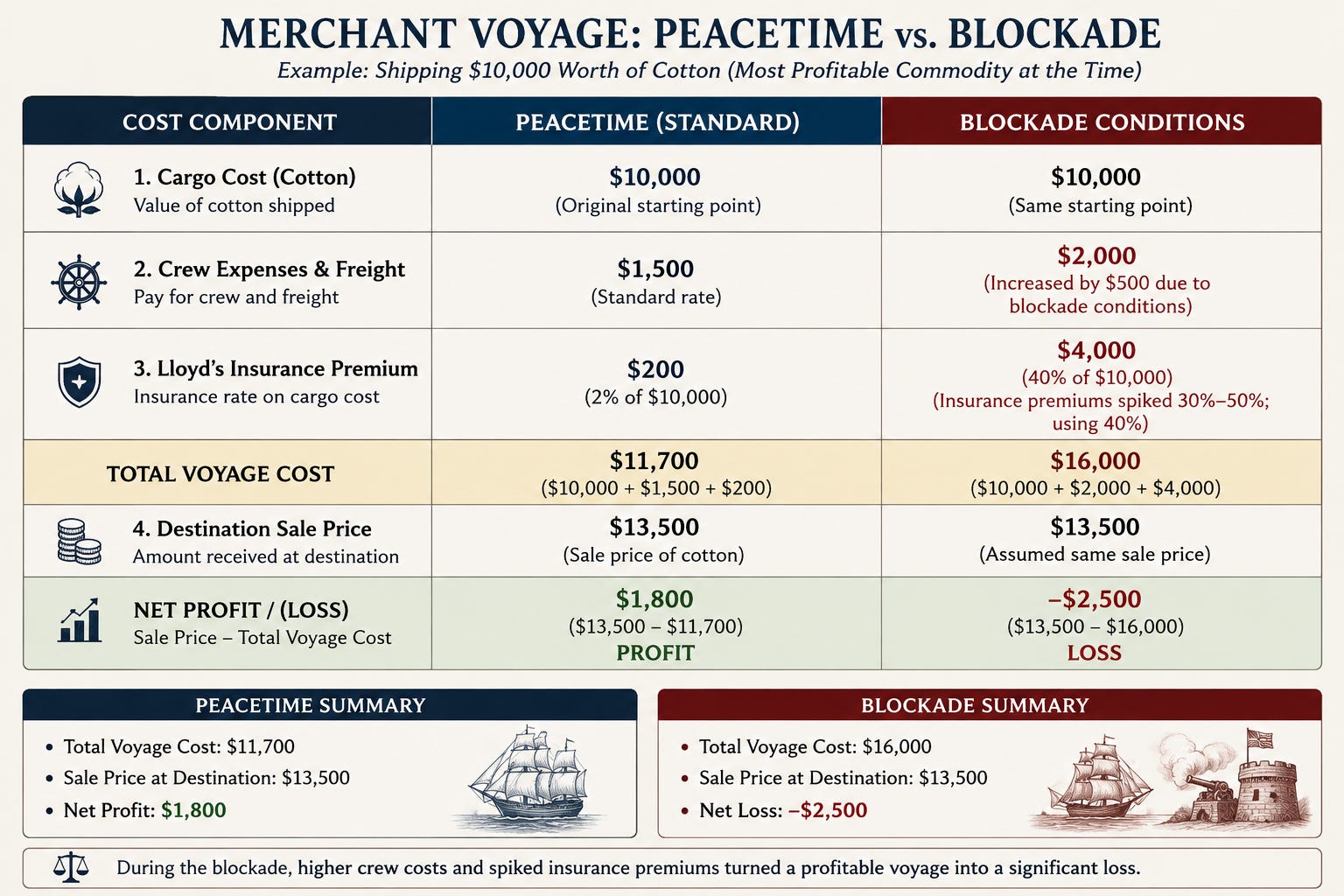
Because of the soaring cost for insurance, merchants are essentially grounded. No Ports, or a commercial bank would allow the ships to leave uninsured. From Boston, MA to Charleston, SC, the ships rotted there.
And as for Revenue in the US, which was exclusively reliant on Customs duties, it collapsed 55% in 1814, with receipts in New York collapsing as much as 90% all thanks to the blockade. This means that the government couldn't raise enough money to pay, feed, arm and clothe the army on the Canadian border.
All of this would lead to something that only happened once in the history of the United States: a “bankrupt” Treasury.
How Three Private Bankers Kept America Alive, and Why It Still Wasn't Enough
With customs revenue cut in half, Washington did what every broke government does: it tried to borrow.
In early 1813, Congress authorized a $16 million war loan and asked the American people to buy it. They didn’t. The first round brought in less than $4 million. In New England, the region with the most money, Federalist leaders told people it was “a duty of patriotism to defeat the Government by destroying its credit.” While their own government begged for cash, many of them were buying British government bonds and smuggling gold and silver into Canada.
By May, Treasury Secretary Albert Gallatin wrote to President Madison: “We have hardly money enough to last till the end of the month.”
The rescue didn’t come from a national bank, because Congress had let that die in 1811. It came from three private men. Stephen Girard, a Philadelphia banker, and David Parish, a merchant, took $7,055,800 of the loan. John Jacob Astor and his New York partners took another $2,056,000. All three were born outside the United States.
Their help wasn’t charity. They paid $88 for every $100 bond, so the government took a 12% haircut just to stay alive. When a nation can’t fund its own war, the people who lend to it set the terms.
Even that only bought time. In August 1814, British troops burned Washington, and banks outside New England stopped paying out gold and silver altogether. The Treasury had about $2.5 million in credits, but they were scattered across 94 different banks and couldn’t be moved where they were needed. That fall, the government couldn’t pay the interest it owed investors in Boston, and its own Treasury notes were refused.
The new Treasury Secretary, Alexander Dallas, admitted the Treasury was “suffering from every kind of embarrassment.” Treasury’s own history describes what he inherited as a “bankrupt” Treasury, and the Congressional Research Service calls it an unambiguous default. It was the only time in American history the US government flat-out failed to pay its debts.
Think about what that means. The British never had to march on Philadelphia or New York to break the American economy. The Royal Navy closed the ports, Lloyd’s priced the risk, revenue collapsed, and the government ended up at the mercy of private lenders. The independence won in 1783 meant very little without the financial power to defend it.
America learned the lesson the hard way. In 1816, the same party that killed the first national bank chartered a second one and passed a protective tariff. Henry Clay built his American System on that foundation: national credit, domestic industry, and infrastructure, so the country would never again be one blockade away from bankruptcy.
But one weapon was never answered: the insurance market itself. For two hundred years, whoever writes the policy decides which ships sail. That’s finally starting to change...
The $40 Billion Program that changes the entire Equation
For over two hundred years, through two world wars, the Gulf War and every conflict in the Middle East, shipping insurance spiked, and London's war-risk market cashed in.
That changed in 2026.
In February, US and Israeli forces launched military operations against Iran. Iran answered by threatening and attacking commercial ships in the Strait of Hormuz, the waterway that carries more than a quarter of the world’s seaborne oil trade. Just like in 1812, the shooting war came with a second war: the insurance market. Lloyd’s Joint War Committee listed the entire Persian Gulf as a high-risk area, war-risk policies were canceled or repriced, and traffic through the Strait nearly stopped.
This time, Washington didn’t wait for three private bankers to bail it out.
On March 3rd, President Trump ordered the US International Development Finance Corporation (DFC) to provide, in his words, “at a very reasonable price, political risk insurance and guarantees for the Financial Security of ALL Maritime Trade, especially Energy, traveling through the Gulf.” Three days later, the DFC pledged $20 billion, almost ten times larger than any active commitment it had ever made.
On April 3rd, it doubled. The DFC brought in seven American insurers: Chubb as the lead underwriter, plus Travelers, Liberty Mutual, Berkshire Hathaway, AIG, Starr and CNA. Together they added another $20 billion, for a $40 billion rolling facility covering war risk on ship hulls, liability and cargo. Chubb sets the prices and handles the claims, and the US government vets every ship that applies.
Think about what that means. For two hundred years, a committee in London decided which trade routes were too dangerous, and the whole world paid whatever price London set. Now the United States has built its own insurance backstop, underwritten by American companies and backed by the American government. It’s the American System applied to the ocean: national credit put behind American commerce, so a foreign market can’t shut it down.
Cui bono? American insurers win a market London has owned for centuries, and American and allied shippers get a second option when Lloyd’s says no.
But here’s the honest part: the program has barely been used. As of May, it hadn’t written a single policy, because brokers said it only worked for ships sailing under US naval escort. US forces have since guided tankers through the Strait, but as of mid-October there was no public update on whether policies are being written. And $40 billion is small next to a Congressional Research Service estimate that Hormuz shipping could need as much as $352 billion in coverage.
So the kill switch London held over America in 1812 hasn’t been taken away yet. But for the first time, America has built a switch of its own.
The War That's Finally Ending
History books will tell you the War of 1812 ended in a draw. On paper it did. The Treaty of Ghent gave back no land and settled no grievances, and both sides went home.
But look at what it cost America. The British never had to conquer New York, Boston or Philadelphia. They closed the ports, let London price the risk, and watched the revenue dry up. Within two years the United States, a country that had beaten the most powerful empire on earth for its independence, couldn’t pay its own debts. It had to beg three private bankers for money and still ended up with a bankrupt Treasury.
That was the real war. Not muskets against cannons, but premiums against tariffs and credit against cash. America lost that one.
Every generation since has relearned the same lesson. Whoever controls the money controls the outcome, and for two hundred years the price of moving goods across the ocean was set in a 1.1-square-mile district of London. Every war, every crisis, every closed strait came with a bill, and the bill was written over there.
Alexander Hamilton understood this before the war even started. Henry Clay built a whole economic system on it after the war ended: national credit, domestic industry, and the infrastructure to move American goods. Political independence without financial independence is just a nicer-looking form of dependence.
In 1814, when the shooting war came, America had no national bank, no backstop, and nowhere to turn. In 2026, when the shooting war came again, America built its own.
It’s not finished. The program is young and barely tested, and London still holds the bigger hand. But for the first time in two centuries, the country that once went bankrupt waiting on someone else’s insurance has written its own policy.
The shooting war gets the headlines. The money war decides who wins.
And the one London has been winning since 1812 is finally coming to an end.