
The Truth About ISM Manufacturing Prices Index and What It Actually Represents
ISM manufacturing prices is a leading indicator for what would the PPI look like down the road.

Here you are sitting down in your home from a day off at work. You decided out of the random blue to tune in to CNBC. You see that today, the ISM Manufacturing Index read at a 50, and people are celebrating like it is good news!
The problem is, your head is spinning around like a wedge tornado, trying to figure out what the heck all of this means!
Firstly, what’s ISM?
ISM stands for Institute for Supply Management and they are a leading organization globally in supply management and they serve purchasing industries. But what’s supply management?
Supply management is basically where business purchases and uses raw materials needed to produce their finished goods, there’s much more to this definition, but just for simplicity we will leave it at that.
Now why is ISM Purchasing Managers index important? Pretty much it tells you where the overall economy is going.
Now, the key phase is “business purchases and uses raw materials needed to produce their finished goods.” This means that business purchases material from suppliers, get these materials to manufacturing plants, and in order for the material to get to the plants, business will have to hall the goods by using trucks to get to the plants.
Then, after products is finalized, business then sells the finalized product to consumers at least 10x the cost it took for the product to be made.
And ISM captures all of that in their PMI! But now we need to talk about the elephant in the room that people aren’t talking about: ISM Manufacturing Prices Index.
What the ISM Manufacturing Prices Index Really tell You
The ISM manufacturing prices index basically tells you the cost that manufactures pays for the raw materials.
Now you can type in “ISM Prices Index” on your search bar, major outlets will give you the data on it.
As of April 1st, the reading is at 78.5% which is the highest since 2022, more importantly, this index searched 19.3 points since the beginning of the year. Have a look below.
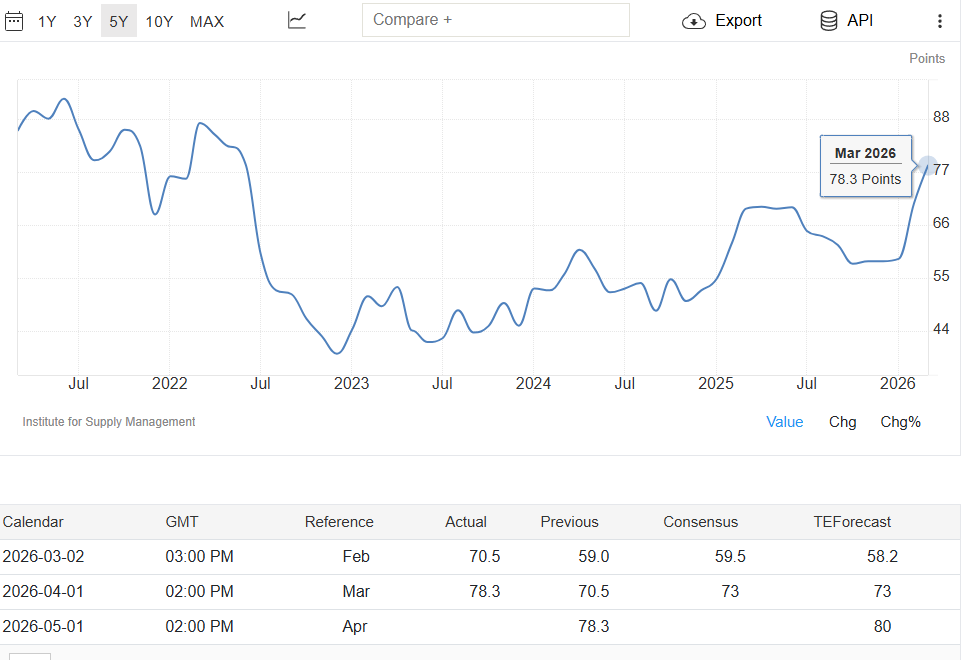
What’s the reason for this huge increase?
It’s because of cost of petroleum based products being increased thanks to the on going Iranian war, and finally higher steel and aluminum costs all thanks to the tariffs on these products.
Now you’re wondering “ Gee, what’s an example of petroleum based products?” Great question! here’s a list:
- Shampoo
- Toys
- Lotion
- Toothpaste
- Trash Bags
- Jet fuel
- Carpets
- Asphalt
Yeah I’ll stop right here. Very long list, but we all use at least 1 of those products everyday.
Now on my article regarding tariffs (which you can check out on the article below) I mentioned that companies that imports material from other countries raise their price to cover the tariff they paid to the government. This process is called a pass through!

On top of that, consumers have increasingly become more delinquent and defaulting on their loans, which means for the banks that has been lending out in the system, it will cause them to lend less in the system, which would lead to deflation.
Now on the business side of things, this means the business are unable to pass the costs to the consumer. And as the raw material costs continue to increase and businesses can’t pass the rising raw material cost to consumers, this will cause 2 things to happen:
1. PPI (Producer Price Index) significantly increases.
PPI tracks prices of a wide range of products from raw material to finished goods and services. The Bureau of Labor Statistics on a monthly basis issues the PPI reading. A raise in ISM manufacturing prices paid means PPI would more than likely increase.
Does CPI (Consumer Product Index, a key economic indicator that measures the average change over time in prices paid by consumers for a representative "basket" of goods and services, such as food, energy, housing, and transportation) increase in this situation? The answer is NO. Many assume a rise in PPI = a rise in CPI.
Under an inflationary environment, there must be a stable or decrease in PPI, while a increase in CPI.
2. The 2 words that business hates the most: Margin. Compression.
What’s Margin Compression? Basically it is where the gap between Revenue and the Cost of Goods Sold (The cost of making the product) narrow. This leads to less capital being available for businesses to grow, to reinvest or to upgrade tech.
And what does business do to address to address this issue? They:
1. Layoff people.
Layoffs has unfortunately been on a bull run, where through November 2025, over a million people saw their jobs being lost. Which sectors saw heavy losses? It was manufacturing and retail!
2. Cut salaries of workers.
In addition to laying off people, business will cut salaries in an attempt to expand their margins.
This is particularly the reason why last year, there has been a major surge in corporate bankruptcies amongst the retail and manufacturing sectors, it’s because of margin compression.
In an inflationary environment, it would be the complete opposite:
Margins Expand, ISM prices paid decreases, a boom in the job market, an increase of salaries, banks lending into the economy, and people spending in the economy. That means PPI should be going down, while CPI should be increasing.
What we are seeing is the complete opposite: CPI decreasing while PPI is increasing.
Now ISM prices paid index is a leading indicator, so, to get the full picture, you take that, along with the current credit conditions amongst consumers, along with corporate bankruptcy trends amongst retail and manufacturing, the ongoing tariffs, and you get a picture if business is booming or busting.
When you get the bigger picture, then you can use the information to position accordingly. That’s how this game is always played.