

When people think about the word war, they think about missiles, fighter jets, tanks, troops, you name it.
But, in this current environment, where the United States and Israel is in a war with Iran, it has caused massive hysteria about World War III taking shape.
I’ll make it something very clear: that will never happen.
Why?
Nobody wins! It’s that simple. It benefits nobody.
Key word is benefits. In case you didn’t know, the entire world system revolves around 2 words, and one question: “Cui bono?”
It’s Latin for “Who benefits?”
You see, all wars are banker wars, specifically for commercial banks and these are what I like to call “profitability of last resort”.
When consumers and businesses starts being delinquent or defaulting on the loans they take on, or file for bankruptcy, the profitability of banks diminishes because they are going to have to write the loans off, and set money aside for provisions. Suddenly, they are facing in solvency!
So what does the commercial banks do to ensure they don’t be insolvent?
They lend aggressively to the defensive sector!
If there were to be a nuclear war that were to take place, there would be massive amounts of radiation that would ruin soil and land, therefore, no crops to grow, no buildings to rebuild, reconstruction would cost hundreds of trillions, societies collapse, you name it.
Is it the worth the risk to go to nuclear war? NO!
Now that we have clearly established why Nuclear War Won’t happen, our focus won’t be on who is involved, our focus will be on those who aren’t involved and I will list out the winners and losers from this entire ordeal. But before we decide who wins and loses, we need to establish the elephant in the room.
The One Passage That Controls A Chunk of The Global Oil Supply
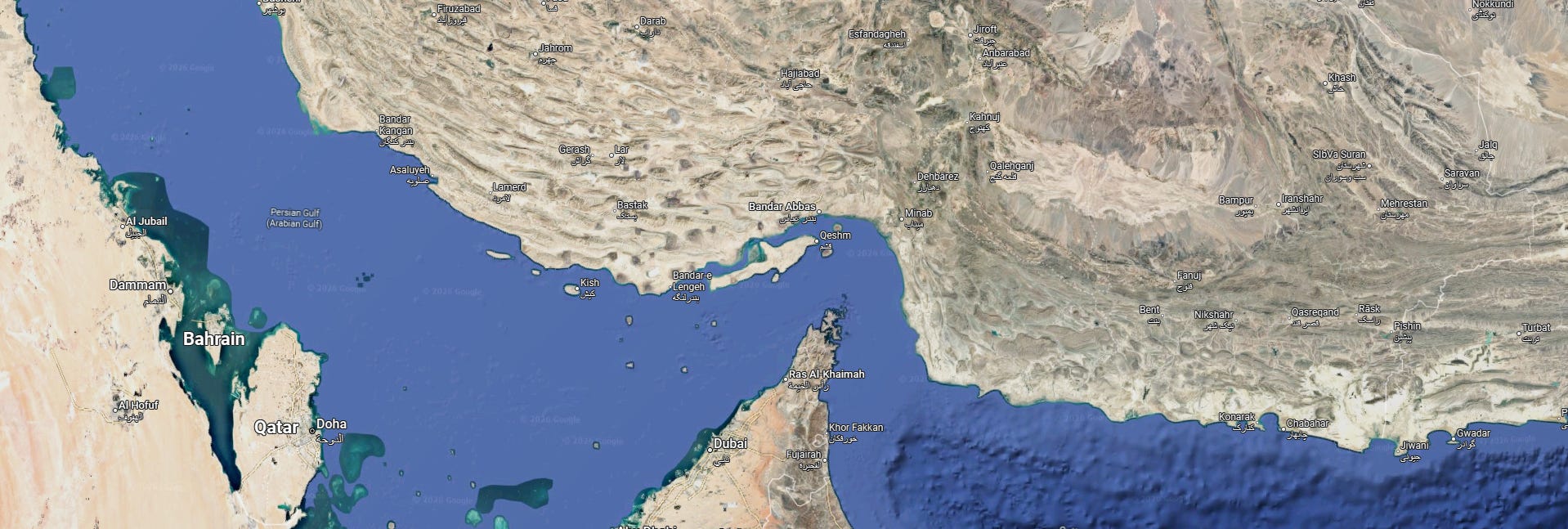
Do you see this little passage in the map above? This is called the Strait of Hormuz.
Located between Iran to the north and Oman to the south, it’s the only maritime exit from the Persian Gulf. At its narrowest, the shipping lanes are just two miles wide in each direction — yet it handles roughly 20-21 million barrels of oil and petroleum products per day. That’s about 20% of global oil consumption and around a quarter of all oil traded by sea. Qatar also exports nearly 20% of the world’s liquefied natural gas (LNG) through the same choke point.
This is exactly where Middle Eastern oil and LNG travel through, with a super majority exported to Asia. China alone takes nearly 38% of the flows, followed by India, Japan, and South Korea. Together, these four countries account for roughly 75% of the oil moving through the strait.
All of them are heavily reliant on energy from this region so they can continue to sell things to the world as export-driven economies.
Right now, in the ongoing US-Israel war with Iran (Operation Epic Fury), the strait has become ground zero for escalation. Iran has effectively closed it to most commercial traffic by laying mines, threatening to attack or set ablaze any non-Iranian-linked vessels attempting passage, and launching drone/missile strikes on ships. Tanker traffic has dropped dramatically — often to near zero — trapping dozens of vessels and halting flows of about one-fifth of the world’s oil and significant LNG volumes.
In the winners-and-losers game of global energy, this tiny passage is the ultimate kingmaker.
Gulf exporters (Saudi Arabia, UAE, Iraq, Kuwait, Iran) normally win big from secure access and pricing power. But whoever controls (or can threaten) the strait holds massive leverage — especially Iran on the northern shore.
The clear losers? The Asian importers whose factories, economies, and global trade machines run on this lifeline. Disrupt it, and energy prices spike worldwide, hitting consumers everywhere while alternative suppliers (think U.S. shale or non-Middle East producers) suddenly become big winners.
So now, we will list the winners and losers from countries that isn’t involved!
The Winners and Losers when the Iran War is over
Well the moment you are waiting for! Now, because I am a personal bearer of bad news, I have to first out the losers of this war so let us begin!
THE LOSERS:
Loser #1: Japan (!!!)
Now there’s a reason why there’s 3 exclamation marks next to Japan, because it is the biggest loser of them all.
Why?
Well, 95% of oil Japan imports comes from the Middle East. Energy is one of the 2 volatile items in the CPI calculations with the other being food.
And if the oil they import is blocked at the Strait of Hormuz, what does this mean for the Tokyo CPI (The inflation rate in the metropolitan area of Tokyo) and the national CPI?
Well these 2 inflation metrics soar, and that puts pressure on the BOJ to raise their interest rates, which leads to the Yen Carry trade collapsing (I talked about this in depth in an article below!)
The Land of The Rising Sun's Stranglehold On The Financial Markets

Previously on The Market Vigil, I went over how bond yields driving down screams deflation not inflation, and one particular section that I covered was Japan.
This will cause a massive global margin call, and Japan’s economy in general will implode due to the raise in interest rates. That’s why it is unquestionably number 1 on the loser’s list.
Loser #2: South Korea
In case you didn’t know, South Korea is the largest memory chip manufacture in the world and the 2 firms that are in that industry are SK Hynix and Samsung who both combined control 69% of the DRAM market and 49% of the NAND market.
What’s DRAM? It’s volatile memory used in computers and other devices to store data temporarily. Where is it used? Well other than computers, Your mobile device uses it, and game consoles (PlayStation, Xbox, Nintendo) uses this.
NAND memory is a type of non-volatile storage that retains data even when powered off. This is found in USB drives, memory cards, and a very popular item amongst people who loves building computers: Solid state drives.
Before the war, there’s already a memory chip shortage thanks to AI’s demands for it, and it has caused prices of flagship consoles like PS5, Xbox Series X/S and Nintendo Switch 2 to raise their prices.
Now what is the most important element memory chips need? Helium! Who provides it?
QATAR!
South Korea imports 35% of helium from Qatar, not just that, but in general, they import 20% of LNG and 72% oil from the Middle East.
Since the Strait is blocked off, Not only will South Korea get their oil and LNG, they won’t get their Helium!
So not only will inflation kill them, effectively weakening their currency, the Korean Won, their huge money maker (South Korea, like Japan is an export-driven economy) which is selling memory chips will stop making money, and that means their economy will collapse like origami. Talk about a double whammy!
Loser #3: Western Europe
Western Europe isn’t as hooked directly to the Strait of Hormuz as Asia, but don’t let that fool you — a prolonged disruption still destroys them.
No major innovation in the last 2 decades. Reliant on Russian oil now AFTER lifting sanctions (and they may not get the oil because the Strait of Hormuz is shut down). Can’t be reliant on China… OR the US.
When global prices lock above $100–$120, Germany’s chemical, steel, and auto industries get crushed by energy costs. Inflation reignites, the ECB is forced into higher rates longer, consumer spending collapses, and the slow deindustrialization we’ve already been watching goes into overdrive. Their entire export machine grinds to a halt.
Loser #4: China
China is the 800-pound gorilla of oil importers — and it gets absolutely crushed. A huge slice of their Middle East crude flows straight through the Strait of Hormuz. With the US seizing control of the chokepoint (and blocking Iranian oil exports to China), factory costs explode, supply chains fracture, and their entire export economy takes a body blow.
Even with discounted Russian barrels, the broader energy shock slams manufacturing margins, weakens the yuan, and makes hitting growth targets almost impossible.
Well, that’s the losers for you! Now let’s move to the people that will benefit when this war is over.
THE WINNERS:
Winner #1: India
India played this perfectly. They’ve locked in massive volumes of discounted Russian crude over the last few years. While Japan, South Korea, and China panic over Middle East supply, India’s giant refining industry keeps running on cheap Russian oil and exports high-value products at premium prices. This gives them a clear competitive edge and turns a global crisis into market-share gains.
Winner #2: Russia
Russia is the undisputed champion of this conflict. How? They are the number 3 exporter of oil in the world. Every $10 jump in oil price pours billions straight into the Kremlin’s coffers. With Middle East supply choked at the Strait of Hormuz, the world scrambles for Russian crude and LNG. Higher global prices supercharge their revenues, weaken sanctions impact, and give them massive geopolitical leverage.
Winner #3: Eastern Europe
Eastern Europe already survived the 2022 energy crisis and came out tougher. New LNG terminals, diversified pipelines, and closer US energy ties make them far more resilient. While Western Europe gets dragged down by sky-high costs, Eastern manufacturers (Poland especially) keep running cheaper and pick up market share inside Europe.
Higher energy prices actually accelerate their move into nuclear and local resources — leaving them stronger in the post-war world.
People likes to say “take every opportunity available to you” that is true. How do you do that?
You just ask yourself “Who benefits?”.
You list the winners, and the losers.
And in both sides, there’s always….
AN OPPORTUNITY.
Nicely done