

Here you are in your car, driving home from another hard day at work. You notice that you’re almost on E in your fuel gauge, so you head off to a gas station that you always go to. You look at the sign and it reads that the regular grade price is $1.96! A couple of months ago, the same regular grade price you had to pay was $4.20! What a steal right!?
But when you look take a look at the components that determines what you pay at the station, the biggest component is….
Drumroll please…..
The cost of Crude Oil!
See, Oil is much more than the fuel, it’s literally the lifeblood of the global economy, not just here in the US. When trucks and trains are hauling goods, the ships sailing the cargo, cargo planes fly packages around the world, the factories makes anything you can think of, the military uses their planes, helicopters, fighter jets, tanks, what do they run on? OIL.
So while oil maybe cheap in the short term, if prices continue to crash, it means nobody wants oil, meaning for everyone else in the economy it screams: DEFLATION. And for you, that means you might get cheap gas, but the cost is your JOB.
So let’s break down why you actually should care about what’s going on with oil!
A Crude Oil 101 Lesson For You Part 1: The Basics
Crude oil a very sticky and smelly raw liquid that gets pumped out the ground, before it is refined into various things such as jet fuel (For planes) Diesel (for trucks) Gas (For your everyday car), and everything else that powers what we know as life today.
Now thanks to fracking, the US is the number 1 oil producer as of this year and overall, they are the 3rd highest exporter in terms of gross crude oil exports, behind Russia and Saudi Araba.
Oil follows the classical supply and demand meaning:
If there’s too much supply and weak demand, prices goes south of heaven.
If there’s strong demand with weak supply, prices goes north of heaven.
Now there’s a place where the “official” price of oil gets determined, it’s a place called NYMEX.
Ralph, what’s an NYMEX?
Well NYMEX stands for New York Mercantile Exchange and it’s the world’s largest marketplace for trading in oil futures (That means you place bets on the future price of oil, wither it may got up or down). In simple terms, it’s a stock market exchange for oil. The contract is equaled to 1,000 barrels.
What future contracts do they exactly trade? The NYMEX WTI (West Texas Intermediate) Crude oil future contract, and it is the main type of oil in the US.
How does it work? For 24 hours a day, 6 days a week (From Sunday at 6:00 PM EST to Friday at 5:00 PM EST) you get traders that buy and sell the contracts on the PC, not on the trading floor, WE AIN’T IN THE 80’S ANYMORE!
Anyway, the quoted price comes from the front-month WTI futures contract. This is what airlines, gas stations, shippers, military industrial complex, literally everyone that cares about oil watches it like a hawk.
If you want to know what the ticket symbol is, it’s CL, on charts, is CL1!
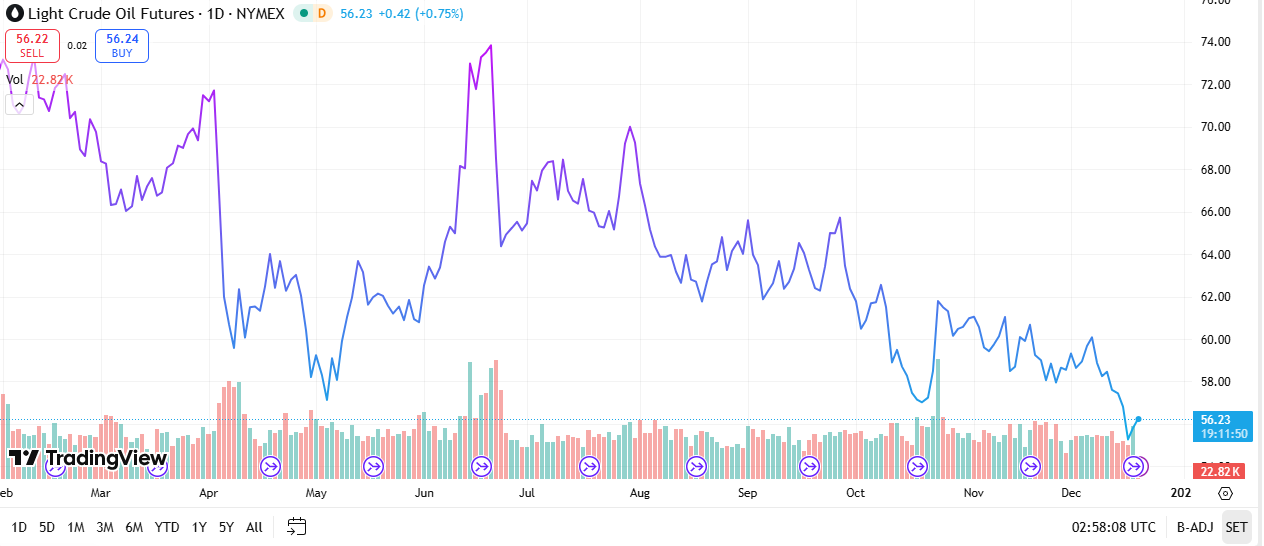
To view this chart, you can go on to tradingview.com, head over to products, click on super charts, and type the symbol, CL1! to check it out.
Note: there’s a 15 minute delay with price updates (indicated by the letter D), you’ll need to get an upgrade to get a live price on oil
Basically, as you can see, oil price has been dropping down the last 3 years, because of of collapse of demand. That’s a textbook sign of deflation!
But WTI isn’t the only king around here, there’s a global version of WTI, and it’s called Brent!
Brent is the global benchmark as it prices approximately two thirds of the world’s oil. It’s slightly heavier than WTI, and also very easy to ship around. Brent trades anywhere between $2-5 higher than WTI due to it’s reach globally.
The ticket symbol is UKOIL, and it is also available on trading view. below is the comparison between Brent and WTI.
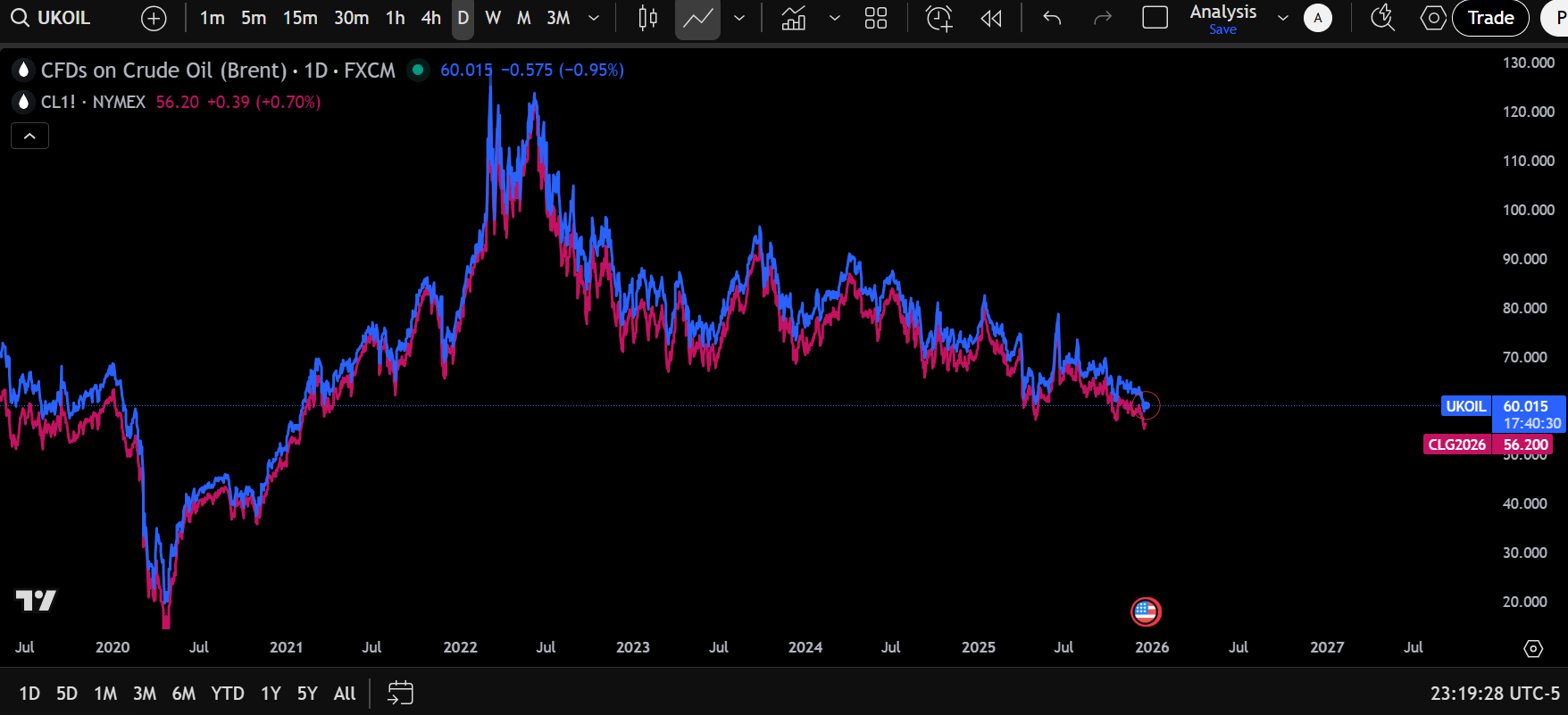
As you can see they follow each other almost to a T! Who leads? Well Brent Leads. Wherever they go, so does WTI. But why do people follow Brent? Well this is where OPEC comes in…..
A Crude Oil Lesson For You Part 2: The Nations That Produces Oil
Alright, so we need to turn the clock back to 1960! Once upon a time, there was 5 countries, 4 in the middle east (Iran, Iraq, Kuwait and Saudi Araba) and one in South America (Venezuela) that got together in some little club in Saudi Araba. The Big boss man, King Saud, who was the King of Saudi Araba at the time in his thick Arabic accent, asked: “Hey, do you guys wish to coordinate production so that we can keep prices stable for our pockets?”
Everyone said replied “Hell yeah! Let’s do it!”
And so the Organization of Petroleum Exporting Countries (OPEC for short) was born!
After their foundation, OPEC got 12 other countries to join them in their cause to coordinate production to keep the prices stable.
In 2016, they expanded to include the 17 countries in OPEC plus 10 non-OPEC allies, and those non-OPEC allies are lead by….
RUSSIA!
And they went from OPEC to OPEC+, what we know today.
OPEC+ today controls anywhere between 30-40% of the global oil production and about 80% of the oil still in the ground (known as proven reserves)
Now every few months, the 27 countries comes together, and they discuss the production target for oil (This is known as a quota).
Now if they decide to cut the output, that means that there’s less supply, leading to higher prices. If they decide to pump a lot well that means lower prices, and that’s never a good sign because it signals weak demand.
So, OPEC+’s oil is priced off Brent and their power ties straight to the benchmarks, among with the fact Brent is easier to ship, OPEC’s decision hit Brent not just the first, but also the hardest as well.
On top of that, if there’s a global event that goes on, it ripples to Brent first, then after that, WTI follows.
Congratulations you just learned oil faster than it took you to brush your teeth, give your self a pat on the back!
Bringing Everything Together To Create The Big Picture
So, in the last 4 Articles what have I talked about?
-CRE dropping causing local governments to raise residential property taxes
-The Yen Carry Trade amplifying the systematic risk
-People being delinquent on their loans causing banks to lend less
-People panic buy bonds because it’s the most liquid, and they don’t trust that Japan or Europe would pay their current debt back
And the reason oil has dropped significantly is because banks have been lending LESS money. That means there’s less demand for goods, meaning that:
A. less cargo for trains and ships
B. trucks hall less goods
C. planes carry less packages
That means that there’s no need for the US to export oil, causing a huge increase in supply, and that means for people with jobs in oil states, they’ve been getting laid off.
Globally, that means that there gonna have to pump MORE oil because of the collapse in demand.
So while you may get cheap gas in your gas station, and you may feel good about it, that comes at a cost of everything else in the economy, including….
YOUR JOB.